
Services
Metal bending & forming
Press brake forming of sheet and plate into angles, channels, brackets, and boxes, holding your angles and flange lengths so parts fit the first time.
Parts that fit the first time
Forming turns a flat blank into a working part, and small errors add up fast. A bend that's a degree off or a flange that's a little long can keep an assembly from going together. We set up carefully, check the first piece against your print, and then run the rest of the order to match.
Because we laser cut our own blanks, we can adjust the flat pattern for the material and tooling, so the formed part comes out right instead of "close enough."
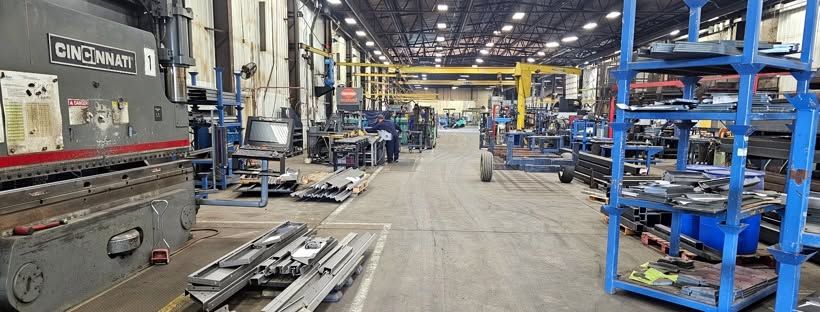
What we form
- Brackets, clips, and mounting tabs
- Angles, channels, U-shapes, and Z-shapes
- Boxes, trays, covers, and guards
- Formed panels and enclosure parts
- Replacement parts formed to match an original
Design tips for formed parts
These general industry guidelines help formed parts come out accurate and affordable. Final values depend on the material and our tooling, so check with us on critical parts.
For mild steel and stainless, an inside bend radius about equal to the material thickness is a safe starting point. Harder aluminum like 6061-T6 needs a larger radius to avoid cracking.
Keep each flange at least about 4 times the material thickness so it can be formed accurately.
Place holes at least 2.5 times the thickness plus the bend radius from a bend line, or they'll stretch out of round.
Where a bend runs into an edge, a small relief notch, at least one material thickness wide, prevents tearing.
The same inside radius on every bend avoids tool changes and keeps the price down.
Formed dimensions hold looser tolerances than flat ones, and they add up with each bend. Dimension critical features from one reference edge.
See the full bending guidelines
What to send for a quote
Send a drawing of the formed part with dimensions clearly marked as inside or outside, plus the material, thickness, and quantity. A flat pattern helps but isn't required. Need a part copied? Bring in the original.
Should I dimension the inside or outside of a bend?
Either works, as long as you label it clearly. Use one convention for the whole drawing and mark the critical dimensions. If you're not sure, send what you have and we'll confirm with you.
Can you copy a part if I don't have a drawing?
Often, yes. Bring in the original part, or send clear photos with a tape measure in the frame. We'll measure it and confirm the details with you before we build.
What should I send for an accurate quote?
A drawing or CAD file (PDF, DXF, DWG, or STEP) is ideal, but a clear sketch or photo with key dimensions works too. Include the material and thickness, the quantity, any finish requirements, and when you need the parts.
Related services
Have parts that need forming?
Send your drawing and get a free estimate.